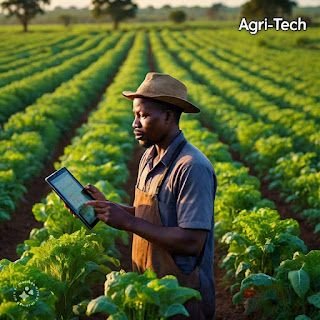
Type of support: Subsidised agricultural inputs
Announced programme value: ₦19.5 billion
Target beneficiaries: 50,000 smallholder farmers
Eligible crops: Maize, rice, cassava and soybeans
The National Agricultural Development Fund (NADF) operates the AgGrow Farm Support Programme to help smallholder farmers reduce production costs and improve farm output.
According to NADF, the programme provides a 50% subsidy on selected farm inputs, including improved seeds, fertilisers and crop protection products. It also connects farmers with processors through structured outgrower arrangements.
Who may qualify?
Potential beneficiaries include smallholder farmers growing the programme’s priority crops and participating in its approved outgrower arrangements.
How to enquire or apply
- Visit the official NADF website: https://nadf.gov.ng/
- Open the programmes and initiatives section.
- Ask NADF whether AgGrow is accepting new farmers in your state and which approved farmer groups, processors or distribution partners are participating.
- Confirm the registration process, farmer contribution and required documents before paying for any inputs.
Important: NADF describes the programme and its targets publicly, but I could not confirm a nationwide application window that is currently open to every farmer. Treat this as an opportunity to enquire about participation, not a guarantee of a new grant award.
Official information: https://nadf.gov.ng/programs-and-initiatives/
2. Renewed Hope Farm Input Support Programme (FISP)
Type of support: Fertiliser and other farm-input assistance
Target group: Selected smallholder farmers
Coverage: Multiple states across Nigeria
The Federal Government, through NADF and the agricultural authorities, has been distributing farm inputs to eligible smallholder farmers under the Farm Input Support Programme.
In June 2026, NADF announced a nationwide intervention involving 515,720 bags of urea and NPK fertiliser for 128,930 smallholder farmers across 25 states and the Federal Capital Territory.
The programme aims to reduce farmers’ input costs, improve yields and strengthen food production.
Who should enquire?
- Smallholder crop farmers
- Farmers cultivating priority food-security crops
- Farmers registered with recognised agricultural associations or cooperatives
- Eligible farmers in states participating in a specific distribution round
How to access support
Contact the NADF or your state’s Ministry of Agriculture to ask whether another distribution round is planned for your location. Ask about beneficiary registration, the relevant crops, farm-size conditions and verification requirements.
The programme’s published distributions do not mean that applications are open nationwide at all times. Inputs are targeted and distributed through designated processes.
Official website: https://nadf.gov.ng/
3. Youth in Agribusiness Land Trust Fund (YiALTF)
Type of support: Youth agribusiness development, access to land and related support
Target group: Young Nigerians interested in agricultural enterprises
The Federal Ministry of Youth Development launched the Youth in Agribusiness Land Trust Fund in partnership with the International Institute of Tropical Agriculture (IITA) in June 2026.
The initiative is designed to help young entrepreneurs overcome barriers to agricultural land access. Its broader support model includes training, finance access, technology, mechanisation services, mentorship, business incubation and market connections.
At the launch, ten young farmers received grants of ₦1 million each to scale up their agricultural businesses.
Who may be interested?
Young Nigerians developing businesses in areas such as:
- Crop production and commercial farming
- Livestock and poultry
- Beekeeping and other specialised agricultural enterprises
- Food processing and agribusiness services
- Agricultural technology and related value chains
How to apply
Visit the Federal Ministry of Youth Development’s official website and check for subsequent application announcements:
The June launch confirms that the initiative exists, but it does not establish that a fresh grant application window is open on 20 October 2026. Contact the ministry or its official programme partners for the next intake.
4. Lagos Agrithon 2026
Type of support: Competitive agribusiness grants
Funding announced: ₦200 million programme allocation
Location: Lagos State
Target group: Entrepreneurs with innovative agribusiness ideas
Lagos State announced the third edition of Lagos Agrithon in June 2026. The programme was designed to support innovative businesses across the food and agriculture value chain.
Eligible business concepts could include food production, processing, distribution, agricultural technology and other solutions that address challenges in the food system.
How did the programme work?
Applicants were expected to undergo a competitive assessment involving application screening, business evaluation, pitching, due diligence and technical review. Selected ventures could receive funding and business-development support.
Is the application still open?
No. The published application period ran from 19 June to 19 July 2026. That deadline has passed.
Entrepreneurs in Lagos can monitor future editions through the programme website:
This is a useful opportunity to watch for a future round, but it should not be presented as an open application today.
5. Nigeria Sustainable Agricultural Value-Chains for Growth (AGROW) Project
Type of support: Agricultural value-chain development, smallholder support and matching grants for eligible agribusinesses
Funding: US$500 million World Bank IDA credit approved for the project
Project period: 2026–2032
The World Bank approved a US$500 million credit for Nigeria’s Sustainable Agricultural Value-Chains for Growth project in March 2026.
The project aims to increase smallholder productivity, strengthen agricultural markets and create jobs. It focuses on value chains such as rice, maize, cassava and soybeans.
One component is a results-based matching-grant facility for agribusinesses that commit to sourcing from smallholder farmers. The facility is intended to support activities such as aggregation, post-harvest handling, processing and market access.
Who may benefit?
Potentially eligible participants may include agribusinesses that:
- Aggregate produce from smallholder farmers
- Invest in post-harvest handling and storage
- Process agricultural products
- Improve access to markets
- Demonstrate a viable business model and measurable benefits to farmers
This is not a general cash grant for every individual farmer. A matching grant also typically requires the recipient to contribute resources under the programme’s terms.
How to follow application announcements
Read the World Bank’s official project announcement and monitor the relevant Nigerian implementing agencies for calls for proposals.
Official project information: https://www.worldbank.org/en/news/press-release/2026/03/31/nigeria-world-bank-approves-project-to-expand-agricultural-value-chains-and-jobs
The project approval is confirmed, but a public application deadline and an open call for every prospective applicant have not been established here. Confirm the implementing agency, application guidelines and funding window before preparing a submission.
6. Renewed Hope Smallholder Support and Value Chain Fund
Type of support: Farm-input support, structured financing, advisory services and market access
Target group: Smallholder farmers and eligible participants in agricultural value chains
The Federal Government announced the Renewed Hope Smallholder Support and Value Chain Fund as part of a wider initiative to support farmers from planting through harvest and marketing.
In July 2026, the government flagged off the distribution of more than 10 million bags of fertiliser and announced a Guaranteed Price Model targeting two million smallholder farmers nationwide.
The model is designed to link participating farmers with aggregation companies, provide farm inputs and support market access. It is therefore broader than a conventional grant scheme.
How can farmers enquire?
Farmers should contact the Bank of Agriculture, recognised farmer associations or the relevant state agricultural authorities to establish whether their location and production activity are included in an active programme.
Ask whether the support is a subsidy, a loan, a repayment-based arrangement or a produce-purchasing agreement. Do not assume that participation means receiving unrestricted cash.
Official sources:
7. Bank of Agriculture (BOA) agricultural financing
Type of support: Agricultural loans and financing, rather than a general free grant
The Bank of Agriculture provides financing mechanisms intended to support agricultural production and businesses. These can be relevant when a farmer needs capital for seeds, fertiliser, irrigation, livestock, equipment, storage or processing.
In October 2026, BOA announced a partnership with the All-Farmers Association of Nigeria (AFAN) to expand access to dry-season financing, targeting 400,000 farmers.
This is a financing initiative, not a blanket promise of free money. Applicants may be subject to credit assessment, eligibility conditions and repayment obligations.
How to enquire
- Visit https://boanig.com/
- Review the bank’s latest programme announcements.
- Contact the bank or a recognised participating farmer association.
- Ask about the current application window, interest rate, collateral requirements, repayment period and eligible farming activities.
Do not pay an unofficial agent who promises guaranteed approval.
8. NADF National Agricultural Development Programme (NADP-1)
NADF’s NADP-1 is an on-lending programme intended to improve access to agricultural finance, inputs and market connections. The initial pilot was announced as a ₦1.5 billion facility, initially targeting maize farmers in Kaduna State.
It is important to distinguish this facility from a grant: on-lending means financing that must generally be repaid under agreed terms.
NADF states that eligible applicants may include smallholder farmers, cooperatives, agribusinesses, processors, input suppliers, storage and logistics businesses and mechanisation service providers.
Interested applicants should approach an approved participating financial institution and confirm the current availability of the facility.
Official programme information: https://nadf.gov.ng/programs-and-initiatives/
Summary: Which programmes should you investigate?
| Programme | Type of assistance | Application status to confirm |
|---|---|---|
| NADF AgGrow | 50% subsidy on selected farm inputs | Ask NADF about new beneficiary intake |
| Farm Input Support Programme | Targeted fertiliser and input distribution | Ask about the next local distribution round |
| YiALTF | Youth agribusiness and land-access support | Check for a new intake |
| Lagos Agrithon 2026 | Competitive agribusiness grants | Published deadline has passed |
| World Bank AGROW project | Value-chain support and matching grants | Monitor official calls for proposals |
| Renewed Hope Smallholder Fund | Inputs, financing and market support | Confirm eligibility through official channels |
| BOA financing | Agricultural loans and structured finance | Confirm current facility and terms |
| NADP-1 | On-lending agricultural finance | Confirm participating institutions and availability |
General eligibility requirements
Requirements vary by programme. Depending on the opportunity, applicants may need:
- Valid identification and contact details
- Evidence of residence or business operations in the eligible state
- Proof of farming activity or agribusiness ownership
- Details of farm size, crops, livestock or production capacity
- A bank account and any required business registration
- Membership of a recognised cooperative or farmer association, where applicable
- A business plan, budget or proposal for competitive grant programmes
- Evidence of a matching contribution for a matching-grant scheme
- Additional documentation requested by the programme administrator
Do not assume every programme requires all these documents. Use the official application guidelines for the specific scheme.
How to apply for an agricultural grant in Nigeria
Step 1: Identify the right opportunity. Decide whether you need free inputs, a cash grant, a business competition, a matching grant or a repayable loan.
Step 2: Check the official announcement. Confirm that the programme is genuine, the application window is open and your state and farming activity are eligible.
Step 3: Prepare your records. Gather identification, farm or business information, a production budget and any required registration documents.
Step 4: Prepare a practical proposal if required. Explain what you produce, the problem you are addressing, how funding will be used and what results you expect.
Step 5: Submit through the approved channel. Use the agency’s official website, verified portal, designated bank or authorised programme partner.
Step 6: Keep evidence of your submission. Save application numbers, confirmation messages and official correspondence.
Step 7: Verify any request for payment. Application fees and beneficiary contributions must be explicitly supported by official programme rules. Never pay an individual who promises guaranteed selection.
Beware of fake agricultural grant websites
Agricultural funding announcements attract scams. The Bank of Agriculture issued a public warning in February 2026 clarifying that applications for the Renewed Hope National Agricultural Mechanization Program and related opportunities had closed, despite misleading online claims.
Before applying:
- Check the announcement on the responsible agency’s official website.
- Verify the opening and closing dates.
- Avoid unofficial WhatsApp or social media registration links.
- Never share your banking PIN, password or one-time verification code.
- Do not assume that a programme described as “government approved” is a free grant.
- Confirm whether the money is a grant, subsidised input package, matching grant or loan.
Conclusion
Nigeria has several agricultural support initiatives in 2026, including NADF’s AgGrow input subsidy, targeted fertiliser distribution, youth agribusiness support, Lagos Agrithon, the World Bank-supported AGROW project and financing programmes through the Bank of Agriculture.
However, the existence of a programme does not mean applications are open today. The most reliable next step is to contact the official programme administrator and confirm the latest intake, location, eligibility criteria and funding conditions before submitting personal information.
For smallholder farmers, input subsidies and targeted distribution may be relevant. For young entrepreneurs, youth agribusiness programmes and competitive grants may be worth monitoring. For established agribusinesses investing in processing, aggregation or storage, matching-grant opportunities may be more suitable when a formal call opens.